The gutter is wet
The first real stretch of Chapter 1: seven layers of depth, painted lights turned into real ones, water that reflects the screen and a light rain.
Listen to this post
Read in Dodz's voice, cloned with AI
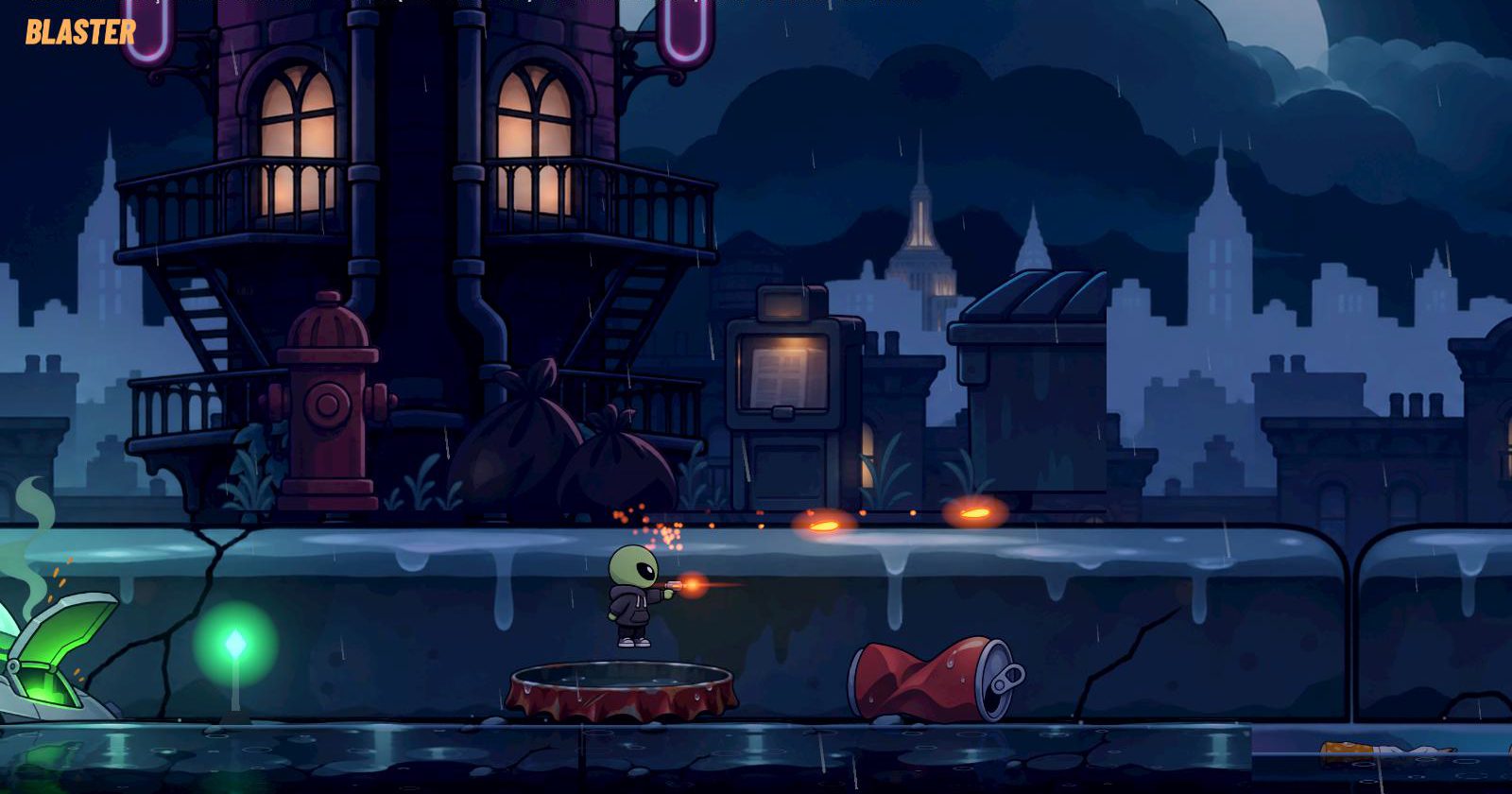
Movement and shooting in a grey room only go so far. Time to put Pew where the story starts: section 1.1 of Chapter 1, the Gutter, right next to the crashed saucer.
The layout
The whole level is a handful of lists at the top of one script: ground pieces, water pools, platforms, targets, checkpoints. The level builds itself from them when it loads, so changing the layout means editing numbers, not dragging nodes around.
From left to right: the saucer where Pew starts, wet asphalt, a bottle cap to climb, a soda can, a first pool crossed by hopping on two floating cigarette butts, chunks of curb, a matchbox, the storm drain glowing in the curb, a second pool with a floating bottle cap, and three alien beacons that work as checkpoints. Fall in the water and Pew sinks, the screen fades, and he's back at the last beacon he lit.
Seven depths
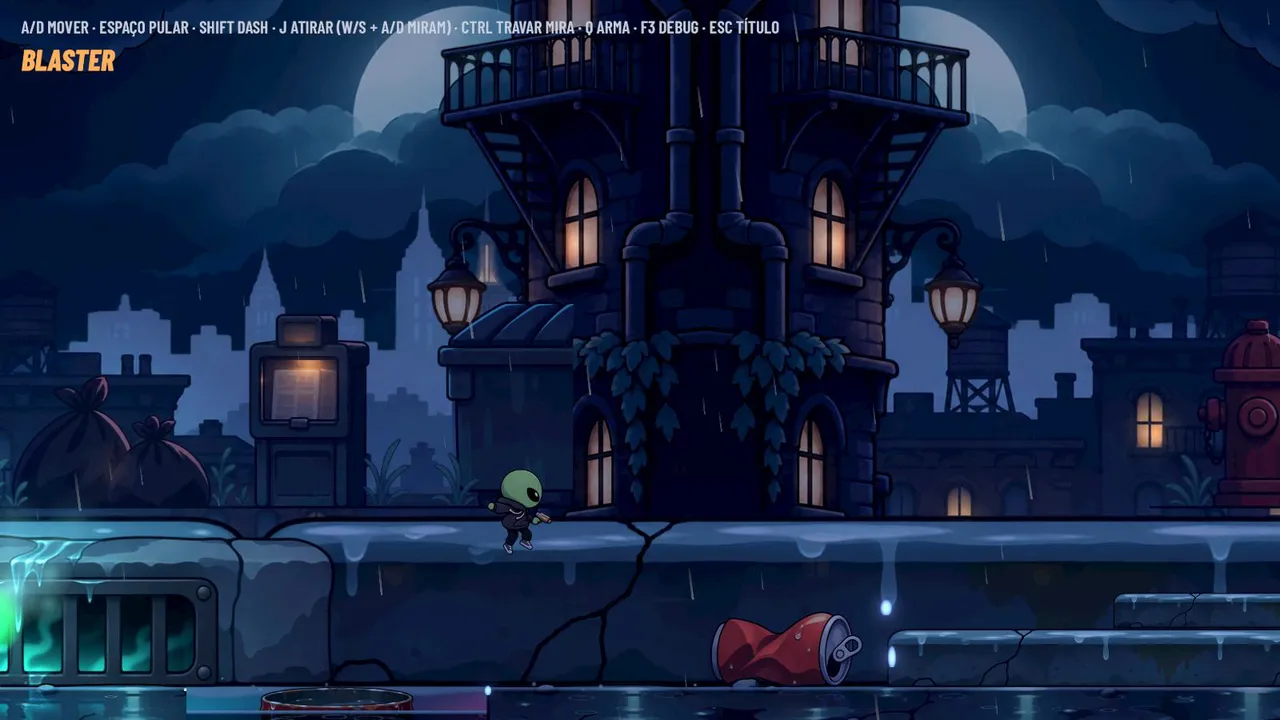
Depth comes from layers. Five painted parallax layers (sky, skyline, buildings, alley, street), then the curb face right behind the play space, and a nearly black foreground passing in front of it all. The parallax layers came from a new image preset that asks only for what a layer should contain. The generator likes to fill empty space with city, so every layer is checked for transparent gaps where they belong.
Parallax is horizontal only. Dense layers repeat as mirrored copies, so the seams disappear. Sparse layers, like the street with its hydrant, repeat with spacing and without mirroring, because otherwise you get a suspicious pair of identical twin hydrants.
Painted lights, real lights
The layers come with lamps and neon painted in. I wanted those to actually light the scene, without placing every light by hand.
So the art export script looks for them. It scans each layer for bright warm spots (street lamps) and pink and cyan ones (neon), merges spots that are close together, and writes their positions and sizes to a lights.json. The level reads that file and puts a real 2D light on each one. A night tint darkens everything, and the lights bring the painted glows back to life. Background lights only touch the background; gameplay lights, like the saucer's open hatch, the drain, the beacons and Pew's shots, light the play space.
Water that reflects the screen
The pools and the wet asphalt use the same node with a shader that mirrors whatever is already on screen above the water's surface, with ripples. It works at any zoom and reflects everything, including Pew and his shots, with no second camera.
Weather
Lightning alternates between a close strike (a strong flash with thunder right after) and a distant one (a faint flash and a late rumble). For Chapter 1 I went with a light rain: fewer drops, fewer splashes on the ground, and a quieter rain loop. It lets the city sounds through.
The last touch was drips. Drops swell on edges, fall and splash now and then: from the saucer's rim, the bottle caps, the curb chunks, the edges of the pools and the drips painted on the curb. When one lands in water it leaves a ring and a quiet plink.
Play it
You don't have to take my word for any of this. The Try Pew section on the home page is this stretch running in your browser, with the same layout, the same autopilot and Pew's real moves.
What's next
On the roadmap, the grey-box prototype milestone asks for movement, 8-way shooting, one enemy, basic interaction and a first version of the water reflection. Movement, shooting and water are in. Next up are the first enemy and the first objects you can push and float on. After that, the plan is a vertical slice of sections 1.1 and 1.2, then the full Chapter 1, and then a public demo of Chapter 1 on Steam.
I'll keep writing it down here.